ABOUT
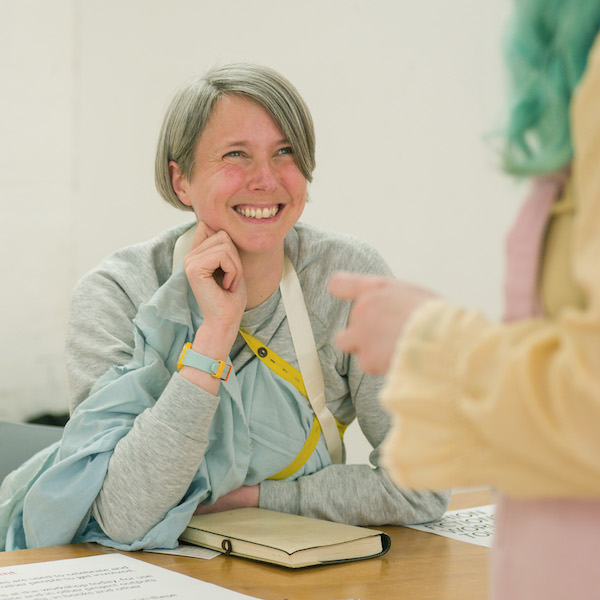
I am a designer, maker, researcher and writer. Through design-led participatory research, I explore plural possibilities for post-growth fashion systems: alternative ways of living with our clothes that meet our fundamental human needs and respect ecological limits.
I currently pursue three strands of inquiry, all relating to participatory speculation for sustainable change in the fashion system and other sectors:
Fashion Fictions
Since 2020 I have explored these questions via my Fashion Fictions project, which brings people together to imagine, explore and enact alternative fashion worlds as an unconventional route to real-world change. Fashion Fictions has been funded by a Research, Development and Engagement Fellowship from the Arts & Humanities Research Council (2021–23) and NTU’s Impact Accelerator Fund; the project has involved more than 6000 participants via over 150 activities in universities, schools and communities worldwide.
The research is generating valuable insights into people's desires for sustainable fashion systems. These insights are revealed via common themes that can be identified across diverse visions, from nature connection and ritual to organisation and rebellion. A book exploring these themes, Fashion Fictions: Imagining Sustainable Worlds, was published in 2025.
Fashion Fictions illuminates the value of collective imagination activities for sustainable transitions. Real-world impacts include the generation of a vibrant and varied repository of creative ideas and artefacts; new thinking about the real-world fashion system and an expanded sense of possibility and agency; and intended and actual changes in individual and collective clothes-related behaviour.
Organizing Differently
My current research, funded by the Philip Leverhulme Prize, builds on my previous work in participatory speculation and alternative fashion systems to explore how the production, exchange, use and recovery of clothes and other forms of material culture might be organized differently.
The project, Organizing Differently, aims to support the flourishing of post-growth systems for fashion and other areas of material culture by speculating on alternative possibilities for organizing. These speculations, generated via participatory workshops, will draw on existing organizational formats but also push beyond them, using a design orientation to devise propositional arrangements of people, resources and material flows that could thrive in a post-growth economy. In doing so, organizing is presented as a space for play and experimentation and capitalism is understood as just one among many possible systems.
Through this practice-based research I am investigating interconnections between designing and organizing. I am interested not only in how organization can be designed differently and how design can be organized differently, but also in resonances between these two widespread processes.
Background
After studying BA and MA in fashion and textile design, I ran my experimental knitwear label, Keep & Share, for ten years. I sold my knitwear nationally and internationally and received awards including the Crafts Council Development Award. My work was featured in many publications, from Vogue to Fashion Theory.
I studied for a PhD at Birmingham City University from 2010 to 2013. Entitled Folk Fashion: Amateur Re-knitting as a Strategy for Sustainability, this work utilised a participatory workshop-based methodology to generate new insights about experiences of making, remaking and fashion. The research formed the basis of my first book, Folk Fashion: Understanding Homemade Clothes (I.B. Tauris, 2017) and the Reknit Revolution initiative and exhibition.
Following my PhD, I was a postdoctoral Research Fellow at the University of Leeds working on an AHRC-funded project that explored how design can contribute to the revitalisation of culturally significant designs, products and practices. A co-edited book, Design Roots: Culturally Significant Designs, Products, and Practices, was published by Bloomsbury Academic in 2018.
Soon after joining Nottingham Trent University in 2016 I co-edited a second book, Fashion Knitwear Design, with my colleague Helen Hill. The chapters were written by the team of specialists who deliver Nottingham Trent University’s highly respected fashion knitwear design courses.
I have an interest in commons and commoning, which dates back to my investigation of the ‘fashion commons’ in my doctoral work. This interest was expanded through leadership of Crafting the Commons, an AHRC-funded network interrogating connections between craft practices and ideas of the commons active from 2019 to 2021. The network informed the development of We Are Commoners, a major touring exhibition by Craftspace in 2021–22.
Another longstanding interest is participatory textile making as a means of research. I coordinated Stitching Together, an AHRC-funded network that aims to foster critical dialogue around participatory textile making in research and practice, from 2019 to 2021.
During the development of the Fashion Fictions project, outlined above, I co-authored another book, Historical Perspectives on Sustainable Fashion: Inspiration for Change (Bloomsbury Academic, 2023) with Jennifer Farley Gordon and Colleen Hill. This project enabled me to focus on the use of historical precedents to inform future sustainability transitions.
In my inaugural professorial lecture from March 2026, 'One Song to the Tune of Another: Alternative Possibilities for Fashion and Sustainability', I reflect on more than two decades of work in the field of fashion and sustainability.
I currently pursue three strands of inquiry, all relating to participatory speculation for sustainable change in the fashion system and other sectors:
- how to design effective participatory speculation experiences
- what kind of speculative visions are generated
- how participatory speculation can impact thinking and behaviour.
Fashion Fictions
Since 2020 I have explored these questions via my Fashion Fictions project, which brings people together to imagine, explore and enact alternative fashion worlds as an unconventional route to real-world change. Fashion Fictions has been funded by a Research, Development and Engagement Fellowship from the Arts & Humanities Research Council (2021–23) and NTU’s Impact Accelerator Fund; the project has involved more than 6000 participants via over 150 activities in universities, schools and communities worldwide.
The research is generating valuable insights into people's desires for sustainable fashion systems. These insights are revealed via common themes that can be identified across diverse visions, from nature connection and ritual to organisation and rebellion. A book exploring these themes, Fashion Fictions: Imagining Sustainable Worlds, was published in 2025.
Fashion Fictions illuminates the value of collective imagination activities for sustainable transitions. Real-world impacts include the generation of a vibrant and varied repository of creative ideas and artefacts; new thinking about the real-world fashion system and an expanded sense of possibility and agency; and intended and actual changes in individual and collective clothes-related behaviour.
Organizing Differently
My current research, funded by the Philip Leverhulme Prize, builds on my previous work in participatory speculation and alternative fashion systems to explore how the production, exchange, use and recovery of clothes and other forms of material culture might be organized differently.
The project, Organizing Differently, aims to support the flourishing of post-growth systems for fashion and other areas of material culture by speculating on alternative possibilities for organizing. These speculations, generated via participatory workshops, will draw on existing organizational formats but also push beyond them, using a design orientation to devise propositional arrangements of people, resources and material flows that could thrive in a post-growth economy. In doing so, organizing is presented as a space for play and experimentation and capitalism is understood as just one among many possible systems.
Through this practice-based research I am investigating interconnections between designing and organizing. I am interested not only in how organization can be designed differently and how design can be organized differently, but also in resonances between these two widespread processes.
Background
After studying BA and MA in fashion and textile design, I ran my experimental knitwear label, Keep & Share, for ten years. I sold my knitwear nationally and internationally and received awards including the Crafts Council Development Award. My work was featured in many publications, from Vogue to Fashion Theory.
I studied for a PhD at Birmingham City University from 2010 to 2013. Entitled Folk Fashion: Amateur Re-knitting as a Strategy for Sustainability, this work utilised a participatory workshop-based methodology to generate new insights about experiences of making, remaking and fashion. The research formed the basis of my first book, Folk Fashion: Understanding Homemade Clothes (I.B. Tauris, 2017) and the Reknit Revolution initiative and exhibition.
Following my PhD, I was a postdoctoral Research Fellow at the University of Leeds working on an AHRC-funded project that explored how design can contribute to the revitalisation of culturally significant designs, products and practices. A co-edited book, Design Roots: Culturally Significant Designs, Products, and Practices, was published by Bloomsbury Academic in 2018.
Soon after joining Nottingham Trent University in 2016 I co-edited a second book, Fashion Knitwear Design, with my colleague Helen Hill. The chapters were written by the team of specialists who deliver Nottingham Trent University’s highly respected fashion knitwear design courses.
I have an interest in commons and commoning, which dates back to my investigation of the ‘fashion commons’ in my doctoral work. This interest was expanded through leadership of Crafting the Commons, an AHRC-funded network interrogating connections between craft practices and ideas of the commons active from 2019 to 2021. The network informed the development of We Are Commoners, a major touring exhibition by Craftspace in 2021–22.
Another longstanding interest is participatory textile making as a means of research. I coordinated Stitching Together, an AHRC-funded network that aims to foster critical dialogue around participatory textile making in research and practice, from 2019 to 2021.
During the development of the Fashion Fictions project, outlined above, I co-authored another book, Historical Perspectives on Sustainable Fashion: Inspiration for Change (Bloomsbury Academic, 2023) with Jennifer Farley Gordon and Colleen Hill. This project enabled me to focus on the use of historical precedents to inform future sustainability transitions.
In my inaugural professorial lecture from March 2026, 'One Song to the Tune of Another: Alternative Possibilities for Fashion and Sustainability', I reflect on more than two decades of work in the field of fashion and sustainability.